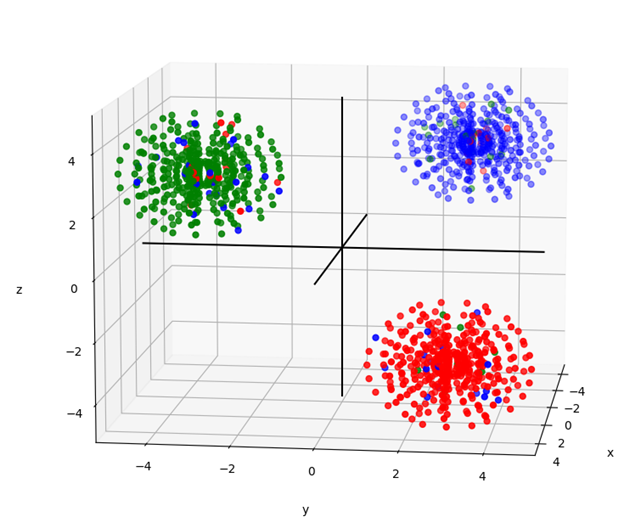
To test the behavior of an algorithm and determine if it works properly, I created a test set with 3 dimensions and 3 classifications from distributions that are defined. In this case they are represented by 3 separate spheres in different quadrants of space. I generated 5% errors into the test set. For example,… Continue reading Random Forest Machine Learning Modeling
Why is forward PE ratio HIGHER than trailing PE ratio for REITS?
I have reason to wonder why several real estate investment trust (REITs) have forward price-to-earnings ratio (PE) that are HIGHER than their current (aka trailing) PE ratio. This suggests that they are forecasting negative growth in earnings. However, looking at eps forecasts, it doesn’t seem negative. Key thing to understand about REITs is they must… Continue reading Why is forward PE ratio HIGHER than trailing PE ratio for REITS?
Rob’s Estimate of a Parabolic Air Conditioner BTU Sizing function
I whittled down the report to focus on what matters to me, which is simply the cooling power, or BTUs. SEER ratings are also important, to save electricity, but what is the point of efficiency if there isn’t enough cooling power?
When shall I update ‘When to Sell’?
Summer raced by and I still owe Part IV to the ‘When to Sell’ series. The answer to when I will update that is I don’t know, but I do plan to. However, it’s not my highest priority. Part IV will require a new code study to create and follow various portfolio rebalancing rules, as… Continue reading When shall I update ‘When to Sell’?
When to Sell, Revisited

Part III. Introduction To understand the effects of a strategic rebalancing schedule, I began a study that compares multiple rebalancing strategies. The premise is that people cannot decide when to sell, and systematic methods to buy and sell would take emotions out of the equation and might work better. I choose to start with a… Continue reading When to Sell, Revisited
Data Considerations for Dividends
This is my first follow up on the Deciding When To Sell post. Step one in any simulation analysis is to understand and validate the historical data. If using price history of an index or ETF to evaluate an asset class, one must be aware that some indices include dividends and some don’t. Historic data… Continue reading Data Considerations for Dividends
Follow up – the Polsky VC contest winner
I eliminated the judges’ choice for the winner early in my consideration. Was I too quick? Do I misunderstand VC investing? The winner’s short profile on the contest page is as follows Andes STR helps people invest in turnkey short-term rental properties. We empower investors to achieve superior returns without any of the hassle of finding… Continue reading Follow up – the Polsky VC contest winner
I judged the VC contest
I listened to the Polsky New Venture Challenge Finalists all day today. Contestants are vying for $1 million in venture capital prize money. I judgmentally judged them, even though I’m not quite qualified to do so. They were all excellent presentations, but regardless, I must identify what’s wrong with their pitch to pick my winner.… Continue reading I judged the VC contest
Deciding when to Sell
For most investors, deciding when to sell is more worrisome than determining when to buy. A systematic method could help by taking away the emotional behavior that gets in the way of selling.
Why Physics
Because the universe is the coolest thing there is. Seriously, matrix mathematics, statistics and probability are prevalent in physics and also in finance, but they were in Physics first. Arguably that is where they are the more interesting and exact. It’s a laws vs. theories thing – Physics has laws, finance has theories. Python and… Continue reading Why Physics
Share this Site


